EMLS – Electromagnetic Launch System
EMLS – Electromagnetic Launch System
Classification:INTERNAL – CONFIDENTIAL
Subject:The Physics of Kinetic Acceleration & Orbital HarvestingMLS – Electromagnetic Launch System
Project Identity: Eco / Advanced Electromagnetic Space Launch
Website: www.emls-project.com
Contact: info@emls-project.com
Classification: INTERNAL – CONFIDENTIALTechnical Report: The Flagella Protocol – Multi-Arm Viscoelastic Capture & Orbital Resource Recovery
AUTHORIZATION Researcher: Naseer Alsharmani
Project: Electromagnetic Launch System (EMLS) Integration1. Design Concept: Bio-Inspired "Euglena" Flagella
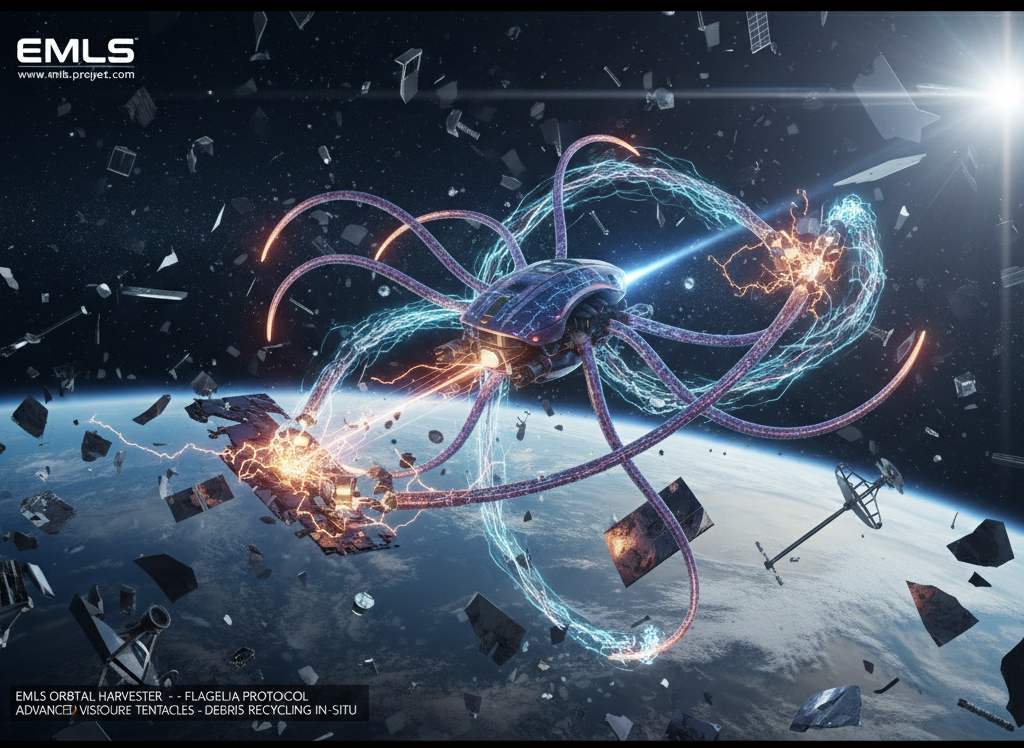
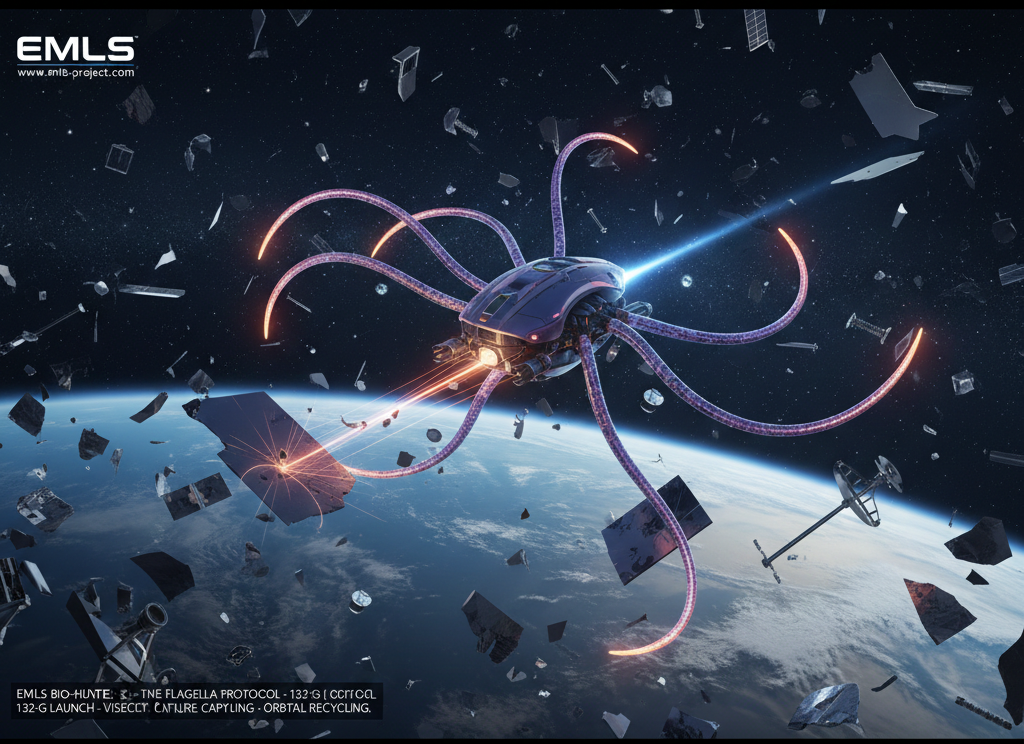
The Bio-Hunter is an autonomous harvesting unit launched via the EMLS. Instead of rigid robotic arms, it utilizes 50 independent Viscoelastic Flagella. These tentacles employ an internal Ferrofluidic Pressure System and Superconducting Coil Bases for 3D spatial orientation, preventing entanglement and enabling multi-target acquisition.
2. Mathematical Modeling of the Capture Mechanism
A. Viscoelastic Damping (Kelvin-Voigt Model)
To prevent the kinetic energy of debris from damaging the hunter, the flagella must act as high-efficiency shock absorbers. The stress (σ) on a flagellum during impact is modeled as:
σ(t) = E * ε(t) + η * ( dε (t) / dt )
Where:
• E: Young's modulus of the carbon-nanotube core (elasticity).
• η: Viscosity coefficient of the internal non-Newtonian polymer (damping).
• ε(t): Strain (elongation) as a function of time.Physical insight: The flagellum extends like a biological lash, converting the debris' kinetic energy into thermal and elastic potential energy without reflecting the shock to the main bus.
B. Conservation of Momentum & Center-of-Mass Shift
When a hunter (mass M_h) captures a debris item (mass M_d), the final velocity (V_f) of the combined system is:
V_f = (M_h * V_h + M_d * V_d) / (M_h + M_d)
To stabilize the system, the 50 flagella redistribute the mass by pulling the debris toward the geometric center of mass, minimizing the moment of inertia (I):
I = Σ (m_i * r_i²)
By reducing the lever arm r (flagellum length), the hunter gains control over the debris's tumbling motion.
3. Orbital Maneuvering & Trajectory Transfer
Once the debris is secured, the hunter transfers to the Orbital Forge (Recycling Hub). We employ a low-thrust spiral trajectory, optimized for plasma thrusters.
Delta-v requirement:
Δv = √( μ / r₁ ) * [ √( 2r₂ / (r₁ + r₂) ) - 1 ]
Where:
• μ: Earth's gravitational parameter.
• r₁: Debris-capture orbit radius.
• r₂: Recycling-Hub orbit radius.Efficiency advantage: Because the EMLS launches the hunter at a fraction of the cost ($7.3/kg), the Energy Return on Investment (EROI) for recycling 1 kg of aluminum is approximately:
EROI ≈ 15:1
(Compared to ~ 1:20 for traditional chemical-rocket-based recovery.)
4. Advanced Physics: Eddy-Current Braking
Before physical contact, the hunter uses its magnetic coils to induce eddy currents in metallic debris. This generates a counter-magnetic field that despins the object. The braking force (F_brake) is approximately:
F_brake ≈ σ * v * B² * Vol
Where:
• σ: Electrical conductivity of the debris (e.g., aluminum alloy).
• v: Relative velocity.
• B: Magnetic-flux density from the hunter’s coils.
• Vol: Volume of the conducting debris.5. Ecological Impact: Atmospheric Preservation
In-orbit recycling avoids the "alumina-cloud" effect. Traditional atmospheric disposal of 1,000 tons of debris would release ~250 tons of metal oxides into the stratosphere.
• EMLS solution: Zero-emission launch + closed-loop in-orbit manufacturing = net-zero space logistics.
Summary for Stakeholders
The Flagella Protocol transforms space debris from an operational hazard into a strategic reserve. By utilizing the EMLS as a high-cadence delivery system, fleets of Bio-Hunters can be deployed to mitigate the Kessler-syndrome threat while supplying raw materials for the next generation of Lunar and Martian habitats
Electromagnetic Propulsion
Core Logic: Operating via the Lorentz Force F = q(E + v \ B ) to achieve hyper-velocity in a vacuum environment.
Efficiency: Achieving a total system efficiency of 85%, significantly outperforming traditional chemical rocketry.
Final Velocity: Acceleration to 11,200 m/s, the precise threshold required for Trans-Lunar Injection (TLI).
Acceleration Profile: Constant acceleration of 1,294.34 m/s^2 over a 45.8km track.
Heading: Inertial Damping & Bio-Payload Integrity
Current Validation Stage: TRL-4 (Technology Readiness Level 4) Our proprietary Smart Hydrogel Damping System is currently undergoing rigorous testing to ensure the survival of sensitive payloads under extreme acceleration.
Strategic Partnership: Testing is conducted at the Gravion Microgravity Lab (France), hosted within the International Space University (ISU) Incubator ecosystem.
The 132 G Challenge: The research focuses on validating hydrogel performance at a constant acceleration of 132 G's, simulating the exact forces of the EMLS launch profile.
Key Benchmark: Preliminary success includes Egg Survival Tests at 100 G, proving the system's ability to protect complex biological structures.
Dual-Purpose Innovation: Once the Earth-escape phase is complete, the damping material is engineered to be repurposed as post-launch propellant, significantly increasing mission mass efficiency.